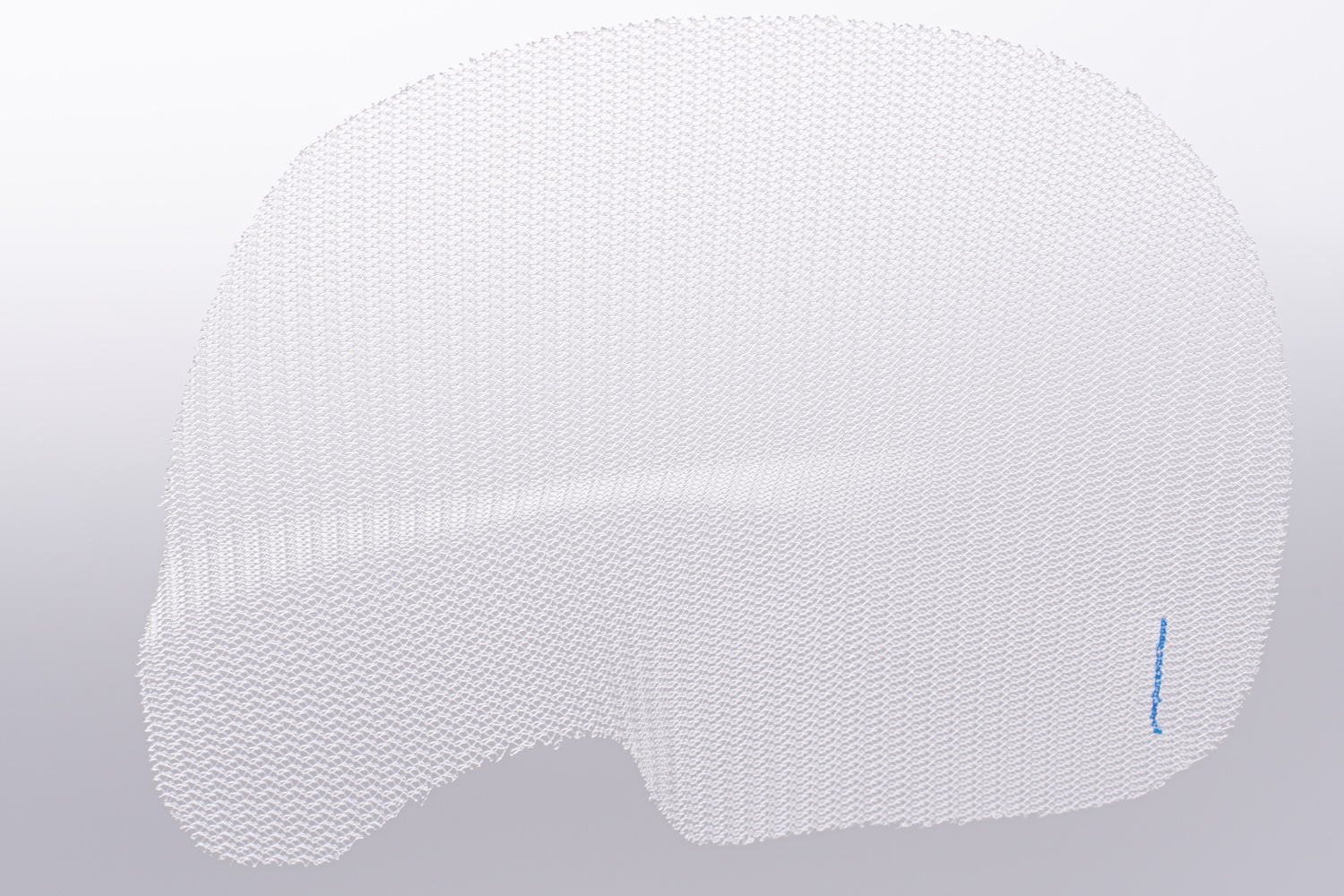
Biomesh P1
Non-absorbable extraperitoneal parietal reinforcement implant
Polypropylene mesh for femoral, inguinal, and ventral wall reconstructions.
Biomesh® P1 is a medium- to heavyweight monofilament polypropylene mesh for extraperitoneal reinforcement of the abdominal wall. It is designed for the management of inguinal hernias (including with preformed 3D implants) as well as ventral hernias and large incisional hernias. Its more robust structure provides significant mechanical load capacity, particularly for large defects or complex reconstructions.
Clinical benefits
Increased stability: higher weight than Premium® for situations with high mechanical stress (e.g. large incisional hernias, complex reconstructions)
- Versatile use: from inguinal hernia repair (including with 3D implants) to large ventral hernias and incisional hernias
- Preformed 3D implants for the inguinal region: anatomical shapes facilitating adaptation to the inguinal canal and potentially reducing operative time
- Large dimensions for ventral hernias: meshes up to 45 × 45 cm for generous overlap of extensive defects
- Proven PP material with a well-known long-term profile
- Compatible with suture, staple/clip, or glue fixation, depending on the chosen operative concept.
Material, stability & implant design
Biomesh® P1 is a monofilament polypropylene implant of approximately 100 g/m². Compared to lightweight meshes, its structure is more stable and less extensible, which can be advantageous in the presence of large defects or those subject to high stress. Despite this higher weight, the mesh remains macroporous to allow adequate tissue integration.
Indications & surgical techniques
Biomesh® P1 is indicated for extraperitoneal reinforcement during inguinal hernia repairs (including with 3D implants), ventral hernias, and incisional hernias. In inguinal surgery, Biomesh® P1 can be used with open, laparoscopic, or robot-assisted techniques, as well as for ventral hernias and incisional hernias. Flat implants of various sizes – from 10 × 15 cm up to 45 × 45 cm – allow extensive coverage with adequate overlap.
Handling, 3D implants & fixation
Biomesh® P1 is available as flat implants and preformed 3D implants for the inguinal region. The 3D prostheses are positioned anatomically on the inguinal floor and fixed at defined points; flat implants can be trimmed to fit defects. Fixation can be performed with sutures, staples, or glue systems, depending on the size, location of the defect, and technique used. Due to the high stability of the material, careful adaptation and sufficient overlap are essential to ensure durable, low-tension reinforcement.
Clinical experience & combination with other technologies
Biomesh® P1 is part of the well-established medium- to heavyweight polypropylene implants in the portfolio. In studies on implant fixation with glue, PP prostheses in this category have been used successfully, with stable results in terms of recurrence and complications. Biomesh® P1 complements lightweight meshes (Premium®) and partially resorbable 4D composite prostheses when priority is given to significant mechanical stress, for example in cases of large ventral defects, repeatedly operated walls, or in obese patients.[1]
[1] Dams A et al. Surg Endosc. 2023;37(12):9105‑9115.
Technical characteristics
Material: monofilament polypropylene (PP) implant, fully non-absorbable
- Weight: approx. 100 ± 15 g/m²
- Design: macroporous knitted implant with increased stability and reduced extensibility; available in flat form and preformed 3D implants for the inguinal region
- Application: extraperitoneal reinforcement during inguinal hernia repairs (including with 3D implants) as well as ventral hernias and incisional hernias (dimensions from 10 × 15 cm to 45 × 45 cm).
Resources
These resources are reserved for registered healthcare professionals and related professionals on our site.
Cyanoacrylate mesh fixation for laparoscopic inguinal hernia repair: a prospective, multicenter, single‑arm study
Mesh shrinkage in hernia surgery: results of a prospective, randomized, double-blind clinical study – German
Three‑dimensional versus two‑dimensional high‑definition laparoscopy in transabdominal preperitoneal inguinal hernia repair: a prospective randomized controlled study
Safety and efficacy in inguinal hernia repair: a retrospective study comparing TREPP, TEP and Lichtenstein (SETTLE)
Study of mesh surface variations used in inguinal hernia repair – Spanish
Laparoscopic inguinal hernia repair: over a thousand convincing reasons to go on
BIOMESH P1 – Product Sheet – English
Learn more
For more information, to receive samples, or to distribute this product, please do not hesitate to contact us!
Contact us!
Biomesh P1 is a class IIb medical device, manufactured by COUSIN BIOTECH S.A.S. Its CE conformity assessment was performed by the notified body SGS Belgium NV (CE1639). The quality system of COUSIN BIOTECH S.A.S has been certified compliant with the requirements of ISO 13485.
Recommendations for use: Carefully read the labeling, instructions for use, and surgical technique before any intervention.