
4DFix
Semi-resorbable parietal reinforcement implant
Partially resorbable wall reinforcement implant with hydrophilic loops
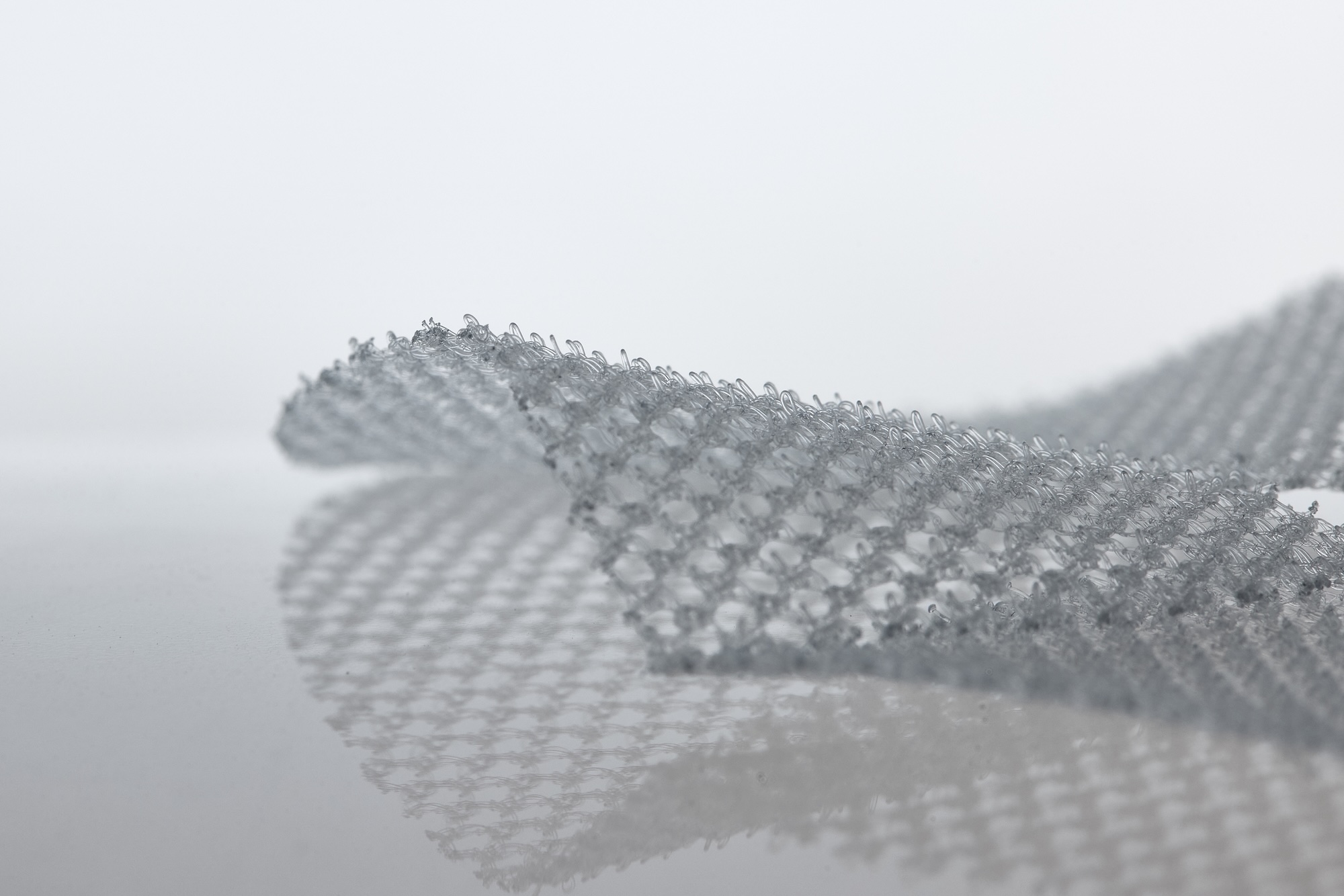
4DFix is a partially resorbable hernia implant for extraperitoneal treatment of inguinal and femoral hernias. Hydrophilic PLLA loops create a grip effect on the abdominal wall. After progressive resorption of the PLLA component, a lightweight polypropylene mesh remains.
Composition: macroporous composite monofilament mesh in polypropylene (PP)
Clinical benefits
Partially resorbable PP/PLLA composite implant: reduces the amount of permanent material implanted while ensuring reliable wall reinforcement
- Hydrophilic loops for gentle grip effect: the implant stays in place; the need for additional fixation can be reduced on a case-by-case basis
- Atraumatically repositionable intraoperatively
- High stability during tissue colonization phase, long-term lightness: PLLA supports initial stability, residual PP mesh ensures lasting recurrence prevention
- Macroporous and transparent: facilitates anatomical orientation and promotes tissue integration
- Cuttable and versatile: pre-cut shapes and adaptability for different surgical techniques and morphologies.
4D grip technology & implant design
4DFix combines polypropylene (PP) and poly-L-lactic acid (PLLA) monofilaments to form a partially resorbable, macroporous hernia implant. Continuous hydrophilic PLLA loops are integrated on one side of the mesh. Upon contact with tissue, they absorb moisture and create a gentle grip effect on the abdominal wall. The mesh thus deploys in a controlled manner, stays in position without traumatic hooks and, as the PLLA resorbs, the amount of permanent material is reduced. A very lightweight, flexible PP mesh remains, well integrated into the tissue.
Indications & surgical techniques
4DFix is intended for wall reinforcement of inguinal and femoral hernias, in extraperitoneal position. Main indications are: open Lichtenstein-type repair, with pre-cut right/left implants (with or without flap), as well as TAPP and TEP laparoscopic repairs with flat or anatomical meshes. The partially resorbable PP/PLLA concept meets the requirements of modern hernia surgery: sufficient stability, good tissue integration and the lowest possible permanent material load.
Use, cutting & fixation in the operating room
4DFix is implanted in extraperitoneal position and deploys rapidly thanks to its shape memory, to position itself against the abdominal wall. Flat variants can be cut to adapt the shape to the anatomy and chosen technique (Lichtenstein, TAPP, TEP). The grip effect provided by the hydrophilic loops stabilizes the position and can reduce the need for additional fixation (suture, staples, glue), while allowing atraumatic intraoperative mobilization and repositioning if necessary.
Clinical and preclinical data on 4D technology
4DFix is based on 4D PP/PLLA technology, used in several hernia implants (e.g. 4DMesh®, 4DVentral®). Clinical studies and registry data on the 4D family show, compared to standard PP meshes in inguinal and ventral hernia surgery, a reduction in postoperative pain, lower seroma/hematoma rates, low foreign body sensation and very low recurrence rates. In vitro data further demonstrate pro-regenerative and anti-inflammatory effects of the PP/PLLA composite. 4DFix transposes this technological concept to extraperitoneal repair of inguinal and femoral hernias in a specifically adapted mesh design.[1–4]
[1] Agca B et al. Early results of comparison of polypropylene mesh and 75% resorbable mesh (PP/PLLA) for TEP inguinal hernia repair. North Clin Istanb. 2019;6(4):388‑392.
[2] Kabaoglu B et al. Postoperative outcomes and recurrence rate in laparoscopic TEP inguinal hernia repairs using partially absorbable meshes. Sisli Etfal Hastan Tip Bul. 2024;58(3):276‑283.
[3] Lund H et al. Recurrence and complications after laparoscopic inguinal hernia repair using a self‑adherent mesh. Surg Endosc. 2025;39(4):2464‑2470.
[4] Daoudi M et al. P‑039 Composite PP/PLLA monofilament 4DVentral® promotes an anti‑inflammatory response from human macrophages in vitro. Br J Surg. 2022;109(Suppl.7).
Technical characteristics
Material: composite monofilament mesh in polypropylene (PP) and poly-L-lactic acid (PLLA), approx. 35% PP / 65% PLLA
- Weight: approx. 30 ± 10 g/m² after resorption
- Design: macroporous and transparent mesh with continuous hydrophilic PLLA loops on one side for atraumatic grip
- Application: extraperitoneal wall reinforcement for treatment of inguinal and femoral hernias; suitable for open Lichtenstein technique and TAPP/TEP laparoscopic procedures
- Shapes (examples): right/left Lichtenstein implants (with/without flap), flat TAPP/TEP implants, preformed anatomical implants for laparoscopy, square implants.
Learn more
For more information, to receive samples, or to distribute this product, please do not hesitate to contact us!
Contact us!
4DFix is a class III medical device, manufactured by COUSIN BIOTECH S.A.S. Its CE conformity assessment was performed by notified body DQS MED (CE0297). The quality system of COUSIN BIOTECH S.A.S has been certified compliant with the requirements of ISO 13485 standard.
Recommendations for use: Carefully read the labeling, instructions for use, and surgical technique before any intervention.