
4DryField® PH – Visceral

Anti-Adhesion and Hemostatic
4DryField® PH is a sterile medical device, a resorbable starch powder for single use, intended for use by physicians or healthcare professionals for hemostasis and adhesion prophylaxis.
4DryField® PH, an MDR-certified 2-in-1 solution, offers both effective adhesion prophylaxis and reliable hemostasis. This plant-based polysaccharide powder can be used directly for hemostasis or converted into a gel by adding sterile isotonic solution, forming a physical barrier that reduces postoperative adhesion formation.
In visceral surgery, 4DryField® PH is used in a wide range of procedures, including adhesiolysis, intestinal resections, hepatic resections, and hernia surgery.
Clinical benefits
In cases of adhesive small bowel obstruction [1]:
-88% of patients completely free of adhesions
-0% recurrent obstructive episodes
• Significant reduction in the extent and severity of adhesions during colorectal resections with second look [2].
• Safety for anastomotic healing has been demonstrated. 4DryField® PH can be applied directly to anastomoses [3].
• Resorption time adapted to the duration of mesothelial healing.
• Offers the best adhesion prevention compared to competing products [4].
[1] Ahmad M & Crescenti F, The Surgery Journal 2019;5(1):e28–e34.
[2] Liu et al., Heliyon 2023;9(11):e21657
[3] Stoerzer et al., International Journal of Surgery Open 2024;62(1):p 6–13
[4] Krämer B et al., Surg Technol Int. 2021 May 20;38:221–233.
Publications
Ahmad & Crescenti (2019) The Surgery Journal
“Significant Adhesion Reduction with 4DryField PH after Release of Adhesive Small Bowel Obstruction”
https://www.thieme-connect.com/products/ejournals/pdf/10.1055/s-0039-1687857.pdf
In this observational study, a pre-mixed 4DryField gel was applied to prevent adhesion reformation in patients with severe adhesive small bowel obstruction. Results show that 4DryField® PH gel significantly reduces the severity and extent of adhesions, as confirmed by reoperations where 88% of patients had no adhesions. Patients were followed for up to 1.5 years and, despite the high severity of pathologies, no recurrent obstructive episodes were observed.
Liu et al. (2023) Heliyon
“Efficacy and safety of purified starch for adhesion prevention in colorectal surgery”
https://www.cell.com/action/showPdf?pii=S2405-8440%2823%2908865-5
In this prospective controlled clinical trial, 101 patients who underwent subsequent surgery after colorectal resection were included. In the intervention group, patients received a pre-mixed gel of 5 g of 4DryField® PH in 50 ml of saline solution, while the control group received no adhesion prevention measures. Results show that 4DryField® PH gel significantly reduces both the severity and surface area of adhesions, without increasing the incidence of complications such as anastomotic leaks.
Lin et al. (2025) European Archives of Oto-Rhino-Laryngology
“The impact of 4DryField PH on hemostasis and postoperative drain placement in thyroid surgery”
https://link.springer.com/article/10.1007/s00405-025-09713-1
This retrospective controlled study of over 200 patients evaluated whether 4DryField® PH powder, used for hemostasis, can serve as an intraoperative indicator for the need to place a drain. In the 4DryField® PH group, a drain was placed only when persistent blood exudate was observed despite reapplication of powder. With this approach, a drain was necessary in only 23% of patients, and no complications related to the absence of drainage were reported. The authors conclude that the use of 4DryField® PH reduced the need for drainage by 77%, while enabling intraoperative identification of higher-risk patients through standardized assessment of persistent exudate.
Poehnert et al. (2016) International Journal of Medical Sciences
“Evaluation of the Effectiveness of Peritoneal Adhesion Prevention Devices in a Rat Model”
https://www.medsci.org/v13p0524.pdf?v=1597757391
In this preclinical study, the efficacy of four commercially available anti-adhesion barriers (4DryField® PH, Seprafilm®, Interceed® and Adept®) for adhesion prevention was compared directly with each other and with an untreated control group. Results showed that 4DryField® PH achieved a significantly greater reduction in adhesion formation than Seprafilm®, Interceed® and Adept®.
Poehnert et al. (2024) International Journal of Medical Sciences
“Comparison of adhesion prevention capabilities of the modified starch powder based medical devices 4DryField® PH, HaemoCer™ PLUS and StarSil® in the Optimized Peritoneal Adhesion Model”
https://www.medrxiv.org/content/10.1101/2023.07.04.23292224v1
This preclinical study compared the efficacy of three starch-based hemostatic powders for adhesion prevention after conversion to gel: 4DryField® PH, StarSil® and HaemoCer™ PLUS. Results showed that neither HaemoCer™ PLUS nor StarSil® achieved a statistically significant reduction in adhesion formation. In direct comparison, 4DryField® PH proved significantly more effective than the other two products for peritoneal adhesion prevention.
The authors conclude that starch-based hemostatic powders do not intrinsically have effective anti-adhesion properties; adhesion prevention rather depends on the specific characteristics and formulation of each product, and only 4DryField® PH demonstrated significant efficacy in this study.
Winny et al. (2016) International Journal of Medical Sciences
“Adhesion Prevention Efficacy of Composite Meshes Parietex®, Proceed® and 4DryField® PH Covered Polypropylene Meshes in an IPOM Rat Model”
https://www.medsci.org/v13p0936.pdf?v=1597757474
This preclinical study compared the adhesion prevention performance of coated composite meshes Parietex® and Proceed® with that of an uncoated Ultrapro® mesh covered with 4DryField® PH gel. Results show that the coated meshes did not significantly reduce bowel-to-mesh adhesion formation, while the uncoated Ultrapro® mesh covered with 4DryField® PH gel resulted in a significant reduction in adhesions. Direct comparison further demonstrated a significant advantage of the 4DryField® PH approach over both coated meshes.
The authors conclude that in the presence of visceral peritoneal injury, application of 4DryField® PH gel may be more effective in preventing bowel-to-mesh adhesions than the use of coated meshes.
Stoerzer et al. (2024) International Journal of Surgery Open
“Impact of the starch-based anti-adhesive agent 4DryField PH on anastomotic healing after rectal Surgery”
https://journals.lww.com/ijsopen/fulltext/2024/02000/impact_of_the_starch_based_anti_adhesive_agent.2.aspx
In this retrospective controlled cohort study, the safety of 4DryField® PH applied directly to colorectal anastomoses during rectal resections was evaluated. A total of 157 patients who underwent colorectal surgery with primary rectal anastomosis were included. The intervention group comprised 57 patients who received 4DryField® in powder form applied directly to the anastomotic site, then converted to gel using saline solution. Results were compared with those of 100 control patients who did not receive 4DryField® PH.
Results showed that application of 4DryField® PH in the vicinity of the anastomosis did not increase the risk of anastomotic leak (AL) and had no adverse effect on other parameters studied. These data demonstrate that 4DryField® PH can be safely applied directly to digestive anastomoses without impairing anastomotic healing.
Key Indications in Visceral Surgery
Adhesiolysis
Intestinal adhesions are among the most common causes of chronic abdominal pain, small bowel obstruction (ileus), and, in women, secondary infertility. Surgical adhesiolysis is often necessary to treat these complications. However, the procedure itself induces extensive peritoneal trauma and carries a high risk of adhesion reformation, with recurrence rates reaching up to 85%. For this reason, effective adhesion prevention is an essential aspect of adhesiolysis procedures.
4DryField® PH can be applied in gel form to separate traumatized tissue surfaces during the critical healing phase and thus reduce postoperative adhesion formation. 4DryField® PH can be applied directly to injured areas in powder form and then converted in situ to gel by instillation of saline solution, or prepared ex vivo as a gel of adjustable viscosity, then aspirated into a syringe for application.
When only a few areas need to be treated, the powder can be applied directly and then converted to gel. However, especially in cases of severe obstruction (common in patients undergoing adhesiolysis), adhesion division sites are located throughout the intestine. In these situations, the use of a pre-mixed low-viscosity gel is particularly convenient.
For this, it is recommended to use 12 to 14 ml of saline solution per gram of 4DryField® PH, applying at least 10 g of 4DryField® PH with 120 to 140 ml of saline solution to obtain a sufficient quantity of gel. After preparing the gel in a sterile container by mixing thoroughly for approximately one minute, it can be transferred to a syringe and applied directly to the areas to be treated.
A video illustrating the application of a pre-mixed low-viscosity gel after adhesiolysis is available below.
Intestinal Resection
Adhesions are a common consequence of intestinal resections and can lead to chronic abdominal pain, intestinal obstruction, or even ileus, often requiring further surgical intervention for adhesiolysis. Effective adhesion prevention should therefore be an integral part of surgical management.
Since hemostasis generally plays only a minor role in this context, 4DryField® PH is most often used in pre-mixed gel form for adhesion prevention. To prepare this gel, 5 g of 4DryField® PH powder is typically mixed with 50 ml of sterile isotonic solution (saline or Ringer’s solution) and shaken thoroughly for at least one minute until a homogeneous gel is obtained. The gel can then be aspirated into a syringe for application.
In laparoscopic surgery, the syringe can be connected to the rigid external tube of the 4DFLap™ applicator, allowing precise application to the target site. In open surgery, the gel can be applied directly to the relevant tissue surfaces. Clinical data have demonstrated both a significant reduction in postoperative adhesion formation and the safety of 4DryField® PH in colorectal surgery, with no increase in anastomotic leak rate.
Hepatic Resection
4DryField® PH is frequently used during hepatic resections, both for hemostasis and for adhesion prevention. Large resection surfaces with diffuse bleeding are common in hepatic surgery, while excessive cauterization should be avoided due to risks of deep tissue necrosis, bile duct injury, and impaired hepatic regeneration.
Even when the primary objective is often hemostasis, 4DryField® PH also provides secondary adhesion prevention. Once bleeding is controlled, the residual powder is typically converted to gel by adding saline solution. Since a blood-free gel barrier is necessary to achieve optimal anti-adhesive efficacy, a sufficient quantity of powder must be applied in cases of more significant bleeding until a continuous white layer is visible before conversion to gel.
A similar approach is used during cholecystectomies when the hepatic bed needs to be treated: 4DryField® PH is first applied in powder form to achieve hemostasis, then converted to gel to ensure adhesion prevention.
A video demonstrating application in powder form and subsequent conversion after partial hepatic resection is available below.
Hernia Surgery
In addition to its hemostatic properties, 4DryField® PH is frequently used for adhesion prevention during hernia repairs with intraperitoneal mesh (IPOM). During hernia surgery, the contents of the hernia sac are often adherent and require extensive dissection.
This can result in areas devoid of peritoneal lining and exposed intestinal surfaces susceptible to adhering to the implanted mesh or other intra-abdominal structures. Such adhesions can cause serious complications, including chronic abdominal pain, intestinal obstruction, female infertility, mesh infection, and fistula formation. Effective adhesion prevention therefore constitutes an essential aspect of IPOM procedures.
For adhesion prevention, 5 g of 4DryField® PH is typically used. Since direct application of powder to a mesh already fixed to the abdominal wall is often impractical, it is generally the intestinal surfaces facing the mesh that are treated. This can be done either by applying 4DryField® PH powder followed by conversion to gel using sterile isotonic solution, or by applying a pre-mixed gel. For gel preparation, a mixing ratio of approximately 1:10 (5 g of powder to 50 ml of saline or Ringer’s solution) is recommended.
Preclinical studies have shown that 4DryField® PH is more effective in preventing bowel-to-mesh adhesions than commercially available pre-coated meshes [1,2].
Furthermore, treatment of injured or denuded intestinal surfaces with 4DryField® PH can also prevent adhesions outside the mesh area itself, an effect that coated meshes cannot provide.
A video demonstrating application in powder form and subsequent conversion during an IPOM procedure is available below.
1. Winny et al. 2016 Am J Transl Res
2. Winny et al. 2016 Int J Med Sci
4DFLap™ – The Applicator for Laparoscopic and Endoscopic Use of 4DryField® PH
For simple and precise application of 4DryField® PH in laparoscopy and endoscopy, the sterile single-use 4DFLap™ applicator has been developed.
4DFLap™ consists of three components:
1. An ergonomic handle with connection for the 4DryField® PH squeeze bottle
2. A flexible internal tube, shape-stable, with memory effect (length 38 cm)
3. A rigid external tube (length 33 cm)
The ergonomic handle, with scissor-type design, allows three different grips. Its textured surface ensures good hold. The connection port for the squeeze bottle can be closed with a finger to prevent loss of intraperitoneal pressure, for example when changing bottles.
The flexible internal tube can be individually shaped and retains, thanks to its memory effect, the desired curvature even after introduction through the trocar. Its internal diameter is optimized for application of 4DryField® PH powder. It can be used with the rigid external tube for particularly precise guidance or alone for maximum flexibility.
The rigid external tube allows exact positioning of the internal tube. It is also suitable for application of sterile isotonic solution to convert 4DryField® PH powder to anti-adhesion gel directly at the application site, or to administer a premixed 4DryField® PH gel.
4DFLap™ is suitable for all areas of laparoscopic and endoscopic surgery where direct application of 4DryField® PH is difficult. The system is compatible with 5 mm trocars.
A short version of 4DFLap™, with a 14 cm tube, is also available for open surgery and pediatric surgery.
Technical characteristics
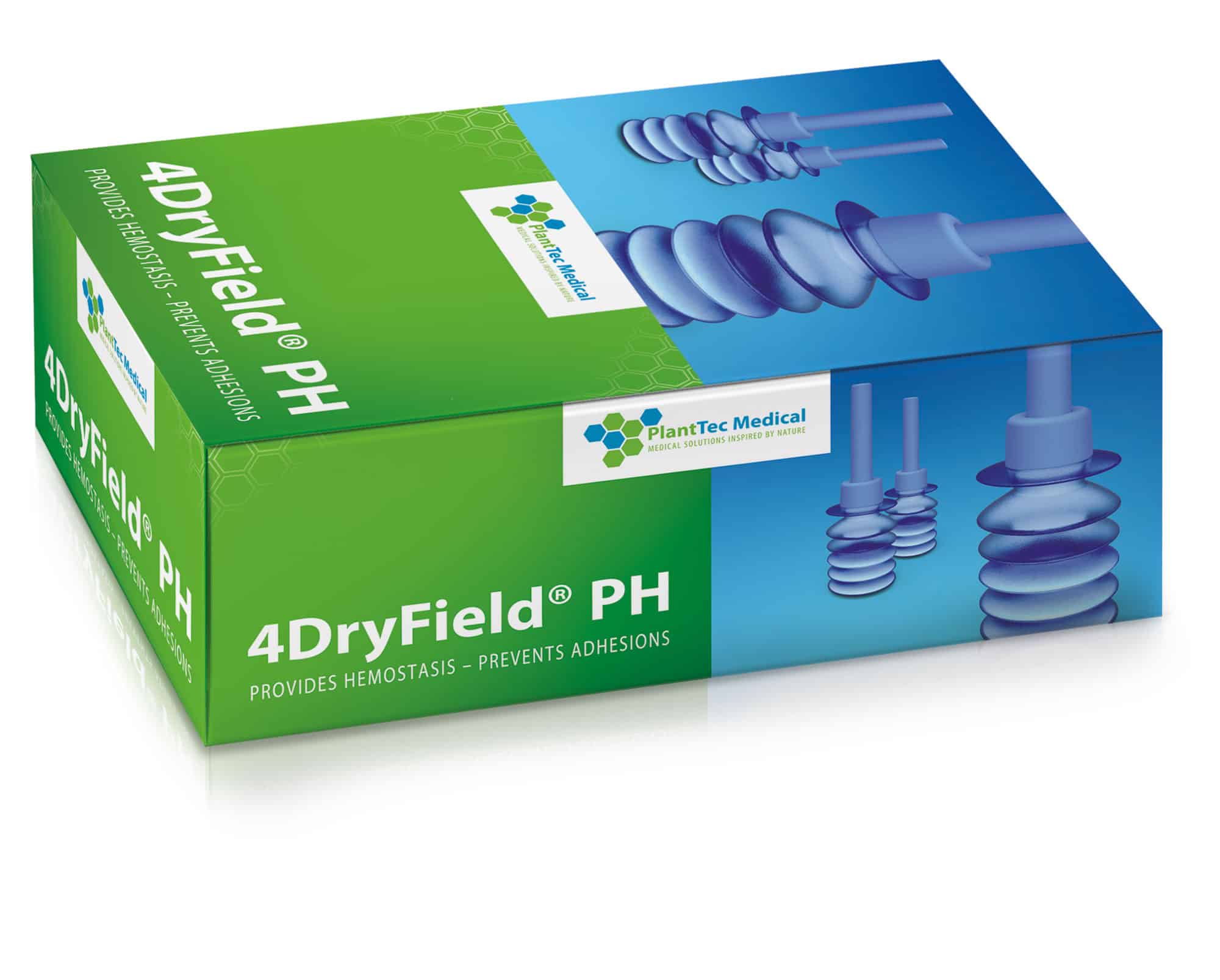
4DryField® PH is supplied in powder form in blue bellows bottles of 1 g, 3 g, 5 g and 9 g, ready to use. One sales unit (box) contains three bellows bottles (3 g, 5 g, 9 g) or five bellows bottles (1 g).
4DryField® PH should be stored at room temperature, protected from prolonged exposure to direct sunlight. No other storage conditions are known beyond normal hospital storage conditions. When stored properly, this product remains fully usable for 5 years.
4DryField® PH is intended exclusively for physicians and healthcare professionals.
Videos
Prevention of adhesions after IPOM placement
After fixing the mesh to the abdominal wall, the adjacent tissues are first covered with 4DryField® PH powder. This is then transformed into an anti-adhesive barrier gel by adding a sterile saline solution drop by drop.
Partial Hepatic Resection - Hemostasis and Adhesion Prevention
After partial hepatic resection of segment VI, 4DryField® powder is applied to achieve rapid and effective hemostasis. Once bleeding is controlled, the powder completely transforms into a gel with the addition of a sterile isotonic solution. This gel forms a protective barrier against adhesions, thereby helping to prevent postoperative adhesions between the liver and surrounding tissues, such as the intestine or the abdominal wall.
Prevention of adhesions after extensive intestinal adhesiolysis
After extensive adhesiolysis, numerous damaged surfaces are present. To cover them uniformly, a significant amount of 4DryField® PH (15 g) is prepared as a low-viscosity gel. For this purpose, approximately 200 mL of sterile saline solution are mixed with the powder (a mixing ratio of approximately 13 mL per gram of powder) and then thoroughly stirred until a uniform gel is achieved. The gel is then aspirated into a syringe, allowing direct application to the areas to be treated.
Learn more
For more information, to receive samples, or to distribute this product, please do not hesitate to contact us!
Contact us!
4DryField® PH is a sterile class III medical device. It is a resorbable starch powder, for single use, intended for use by physicians or healthcare professionals for hemostasis and adhesion prophylaxis.
4DFLap™ is a sterile class IIa medical device, for single use. The applicator consists of rigid as well as flexible and foldable elements for manual administration of the 4DryField® PH medical device (PlantTec Medical GmbH).
These regulated health products bear, under this regulation, the CE marking. Indications, contraindications, warnings and instructions for use are provided in the respective instructions for use. Please read them carefully before use.
Devices not covered by health insurance
.