Committed for several years to an ambitious CSR approach, Cousin recorded an excellent performance in 2025 in reducing CO₂ emissions.
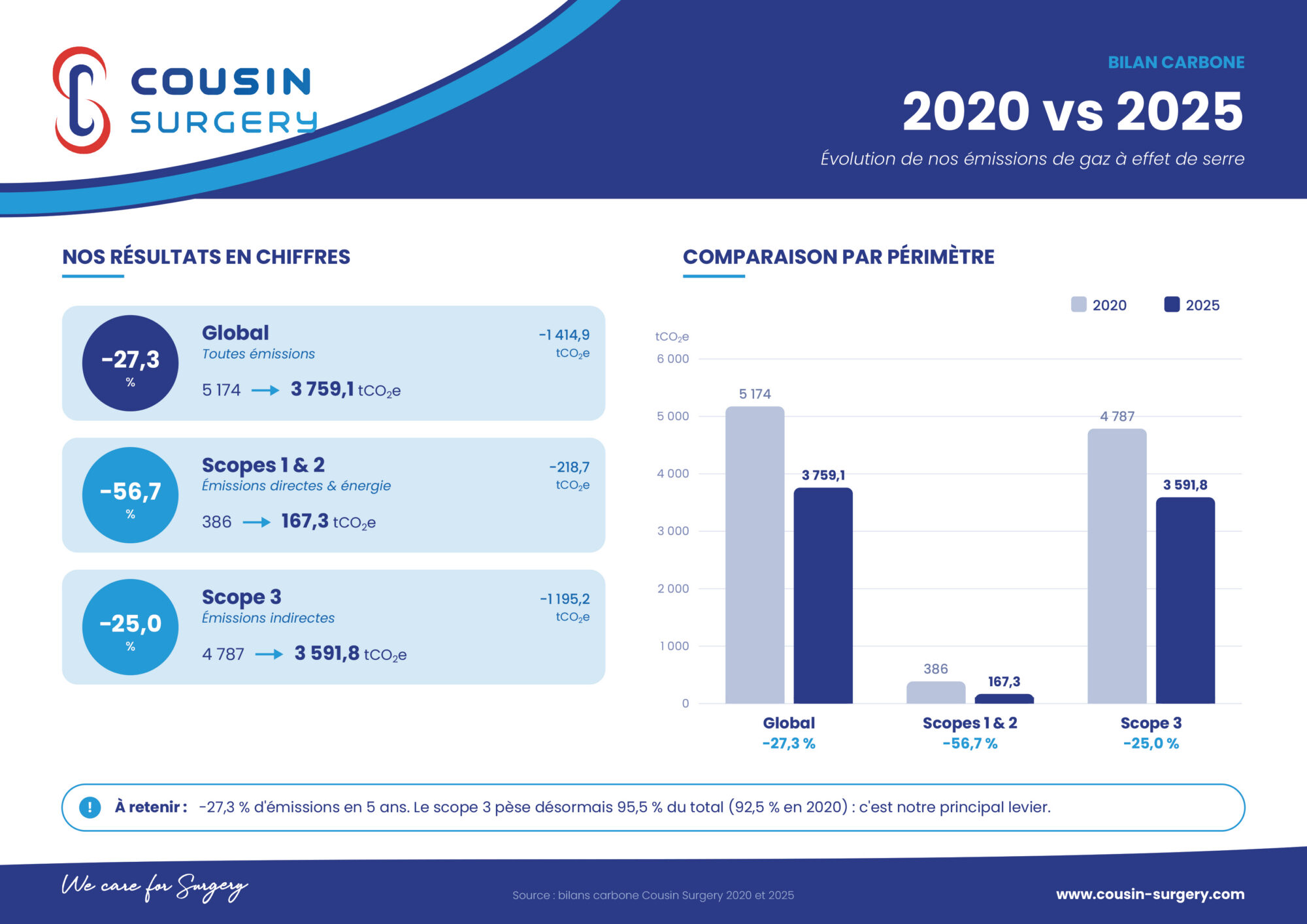
Over five years, our total greenhouse gas emissions decreased by 27.3%, from 5,174 tonnes of CO₂ in 2020 to 3,759.1 tonnes of CO₂.
This reduction represents 1,414.9 tonnes of CO₂ avoided: a result that rewards our teams’ efforts to reconcile economic performance, technological innovation, and the fight against climate change.
The company’s carbon footprint is assessed across three main emissions categories:
- Scope 1 (direct emissions) measures emissions produced directly at our sites (heating, vehicles, etc.
- Scope 2 (purchased energy) covers indirect emissions linked to the electricity, heat, or steam that we purchase and consume.
- Scope 3 (value chain) includes other indirect emissions, upstream and downstream of our production: raw material purchases, transport, end-of-life of products, etc.
Between 2020 and 2025, our direct emissions and those linked to purchased energy (Scopes 1 and 2) fell from 386 tCO₂* to 167.3 tCO₂e, i.e., 218.7 tCO₂e avoided. Our production site emits less carbon thanks to more frugal and better-controlled energy consumption.
At the same time, our indirect value-chain emissions (Scope 3) decreased by 25.0% and fell from 4,787 tCO₂e to 3,591.8 tCO₂e, i.e., 1,195.2 tCO₂e less. This mainly concerns purchasing, transport, travel, and the end-of-life of our products. Scope 3 now represents 95.5% of our total footprint, compared with 92.5% in 2025.
It remains our main decarbonization lever: every choice of material, supplier, or transport matters!
Target -42% by 2030: the strategic framework of the carbon footprint assessment
These results are part of Cousin’s CSR strategy, which aims to reduce CO2 emissions by 5.5% per year through 2030, i.e., a 42% decrease compared with the reference year.
To achieve this objective, the company has launched several significant initiatives: reducing energy consumption, eco-design, digitizing documents, recycling, using recyclable materials for packaging, optimizing delivery routes, , digitizing documents, optimizing air-treatment, heating and cooling loops, vertical integration of processes (thermo-setting, supercritical CO₂ cleaning, membrane manufacturing, silicone injection), etc.
These initiatives aim both to reduce environmental impact and to develop local employment and ensure full control of textile know-how.
This CSR approach is part of a broader vision, inspired by the perma-company concept: taking care of people, preserving the planet, setting limits, and redistributing fairly.