
4DryField® PH – Gyneco

Anti-Adhesion and Hemostatic
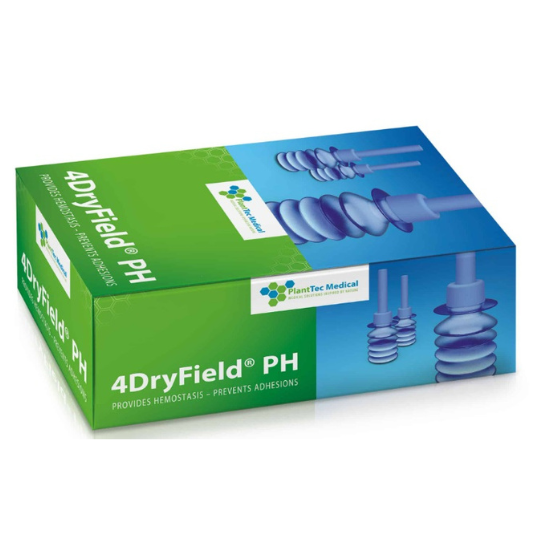
4DryField® PH is a sterile medical device, a resorbable starch powder for single use, intended for use by physicians or healthcare professionals for hemostasis and adhesion prophylaxis.
As an MDR-certified 2-in-1 solution, 4DryField® PH offers both effective adhesion prophylaxis and reliable hemostasis. This plant-based polysaccharide powder can be used directly for hemostasis or converted into a gel by adding a sterile isotonic solution. This gel acts as a physical barrier that reduces postoperative adhesion formation.
In gynecologic surgery, 4DryField® PH is used in particular for the surgical treatment of endometriosis, fibroids, ovarian cysts, cesarean sections, and fertility-preserving procedures. Use in hysteroscopy is also possible.
Clinical benefits
- 85% reduction in adhesions [1]
- Significantly higher pregnancy rate [2]
- Reduced postoperative pain [2]
- Avoids cauterization [3]
- Reduced hematoma formation [4]
- Reduced lymphocele formation [5]
[1] Krämer et al. 2021 Langenbeck‘s Arch Surg
[2] Krämer et al. 2023 J Clin Med
[3] Moszynski et al. 2023 Medicina
[4] Lucas et al. 2021 BMC Musculoskel Dis
[5] Karsch et al. 2016 Adv Urol
Publications
Krämer et al. (2021), Langenbeck’s Archives of Surgery
“Adhesion prevention after endometriosis surgery – results of a randomized, controlled clinical trial with second-look laparoscopy” https://link.springer.com/article/10.1007/s00423-021-02193-x
Prospective randomized controlled clinical trial including patients undergoing two-stage surgery for deep endometriosis. The study compares the use of 4DryField® PH gel with simple saline irrigation for adhesion prevention after resection. The results show that with 4DryField® PH application, adhesion formation was reduced by 85%.
Krämer et al. (2023), Journal of Clinical Medicine
“Improvement in Fertility and Pain after Endometriosis Resection and Adhesion Prevention with 4DryField® PH: Follow-up of a Randomized Controlled Clinical Trial”
https://www.mdpi.com/2077-0383/12/10/3597
This publication presents follow-up data from Krämer et al. (2021). At 12 months, all pain scores (cycle-independent pelvic pain, dysmenorrhea, dyspareunia, dyschezia and dysuria) as well as the rate of patients for whom adhesiolysis was recommended were lower in the intervention group, while the pregnancy rate was significantly higher. The authors conclude that these secondary endpoints confirm the primary endpoint results, namely an 85% reduction in adhesions with 4DryField® PH.
Schäfer et al. (2024), Archives of Gynecology and Obstetrics
“Prevention of peritoneal adhesions after gynecological surgery: a systematic review” https://link.springer.com/article/10.1007/s00404-024-07584-1
For this systematic review article on anti-adhesion barriers in gynecologic surgery, only RCTs including second-look surgery to assess adhesions in the pelvic or abdominal cavity were included. Adhesion scores were used to directly compare the different barriers. Forty-five RCTs involving a total of 4,120 patients were included, examining 10 distinct barrier types in the setting of gynecologic revision surgery. 4DryField® achieved the greatest improvement in adhesion score versus all other barrier agents (85%) and also delivered the most favorable results for postoperative fertility and pain occurrence.
Torres‑de la Roche et al. (2020), Archives of Gynecology and Obstetrics
“A new approach to avoid ovarian failure as well function‑impairing adhesion formation in endometrioma infertility surgery”
https://link.springer.com/content/pdf/10.1007/s00404-020-05483-9.pdf
This observational study on the use of 4DryField® PH in endometrioma surgery shows that 4DryField® PH powder enables rapid hemostasis, thereby avoiding coagulation. At second-look laparoscopy, 85% of patients had no adhesions or only minor adhesions after application of 4DryField® PH gel. The authors conclude that endometrioma resection followed by application of 4DryField® PH as a hemostatic and anti-adhesion agent could be a truly conservative, ovary-sparing approach in endometrioma surgery in infertile patients.
Moszynski et al. (2023), Medicina
“Using a Modified Polysaccharide as a Hemostatic Agent Results in Less Reduction of the Ovarian Reserve after Laparoscopic Surgery of Ovarian Tumors – Prospective study” https://www.mdpi.com/1648-9144/59/1/14
Prospective randomized controlled trial comparing the use of 4DryField® PH powder with bipolar coagulation for hemostasis in ovarian surgery and assessing the impact on fertility. The results show that hemostasis is achieved quickly and effectively with 4DryField® PH, and that bipolar electrocoagulation leads to a significant decrease in AMH levels after 6 months, whereas no decrease is observed with 4DryField® PH. A direct comparison shows a significantly higher AMH concentration in the 4DryField® PH group.
Ziegler & De Wilde (2022), Journal of Obstetrics and Gynaecology
“Reduction of adhesion formation after gynaecological adhesiolysis surgery with 4DryField PH – a retrospective, controlled study with second look laparoscopies” https://www.tandfonline.com/doi/pdf/10.1080/01443615.2021.1928030
This retrospective controlled clinical study on adhesion prevention in gynecologic adhesiolysis shows that 4DryField® PH significantly reduces the severity and extent of adhesions between the first and second procedure, and compared with an untreated control group. Adhesiolysis alone does not lead to a reduction in adhesions. The authors conclude that the use of 4DryField® PH gel is an effective approach to addressing adhesion problems in gynecologic surgery in general, and in particular the problem of adhesion re-formation after adhesiolysis.
Lisa et al. (2024), Minimally Invasive Therapy & Allied Technologies
“4DryField vs. hyalobarrier gel for preventing the recurrence of intrauterine adhesions – a pilot study” https://www.tandfonline.com/doi/full/10.1080/13645706.2024.2351829
Prospective randomized controlled clinical trial on preventing intrauterine adhesions after Asherman surgery, comparing the use of a pre-mixed 4DryField® PH gel with Hyalobarrier®. In patients with severe intrauterine adhesions, 4DryField® PH gel results in a greater reduction in AFS score than Hyalobarrier®, and the pregnancy rate is higher in the 4DryField® PH group. The pre-mixed 4DryField® PH gel also proved particularly convenient for this procedure.
Krämer et al. (2025), International Journal of Gynaecology & Obstetrics
“Intermediate results of a randomized controlled trial on intrauterine adhesion prevention” https://obgyn.onlinelibrary.wiley.com/doi/10.1002/ijgo.70501
This article describes interim results from a randomized controlled trial including patients undergoing hysteroscopic surgery for uterine septum, fibroids or adhesions, with follow-up hysteroscopy. The results show that 4DryField® PH gel reduces adhesion extent by 74% and severity by 69%, and decreases dysmenorrhea as well as the need for adhesiolysis. The authors conclude that 4DryField® PH gel is a valuable new option for preventing intrauterine adhesions and their complications.
Alkatout et al. (2024), Journal of Clinical Medicine
“Adhesion Prevention in Gynecologic Surgery: Guidance and Clinical Experience” https://www.tandfonline.com/doi/full/10.1080/13645706.2024.2351829
This article summarizes the authors’ extensive real-world clinical experience with 4DryField®, covering the following indications: endometriosis, adhesiolysis, neuropelveology, ovarian surgery (cysts and carcinomas), cesarean section, hysterectomy and operative hysteroscopy. When used correctly, 4DryField® PH is considered safe and effective, especially for large lesion surfaces at high risk of re-intervention and adhesion formation, and in patients wishing to become pregnant. Its versatility is enhanced by the option to use it as an in situ gel or as a pre-mixed gel with different viscosities. The authors’ personal clinical experience suggests significant benefits with minimal risk and raises no concerns regarding broad use of 4DryField® PH in gynecology and other surgical disciplines.
Korell et al. (2016), Biomed Research International
“Use of Modified Polysaccharide 4DryField® PH for Adhesion Prevention and Hemostasis in Gynecological Surgery: A Two-Center Observation Study by Second-Look Laparoscopy” http://downloads.hindawi.com/journals/bmri/2016/3029264.pdf
This observational study with second-look laparoscopy demonstrates that 4DryField® PH powder provides effective hemostasis in diffuse bleeding, while 4DryField® PH gel is highly effective in preventing postoperative adhesions after myomectomy, endometriosis surgery, endometrial cancer surgery and extensive adhesiolysis, as confirmed by second-look laparoscopy.
Krämer et al. (2021), Surgical Technology International
“Peritoneal Adhesions and their Prevention – Current Trends” (Review)
https://surgicaltechnology.com/OpenAccess/1385-Kraemer-HR-FINAL-cr.pdf
This review on adhesion prevention in gynecologic surgery concludes that high efficacy is expected from the Gore‑Tex® surgical membrane and 4DryField® PH (although the former is non-resorbable and requires an additional procedure for removal). The authors emphasize the central role of adhesion prevention and consider approaches other than barrier application to be insufficient, while the healthcare system benefits substantially from the use of effective anti-adhesion barriers.
Key indications in gynecologic surgery
Endometriosis surgery
Surgical excision of endometriosis carries a high risk of adhesions and can lead to postoperative complications such as chronic pain and reduced fertility. A randomized controlled clinical study with second-look surgery and 1-year follow-up provides strong evidence of long-term benefits for patients (Krämer et al., Langenbecks Arch Surg. 2021; Krämer et al., J Clin Med. 2023).
- Reduced pain scores (cycle-independent pelvic pain, dysmenorrhea, dyspareunia, dyschezia, and dysuria)
- 85% fewer adhesions
- Pregnancy rate almost tripled
These results show that the main therapeutic goals of endometriosis surgery (pain relief and fertility preservation) can be effectively supported by using 4DryField® PH.
The product can be applied directly to the wound as a powder and then converted into an in situ gel by dripping sterile isotonic solution, or prepared extracorporeally as a gel with adjustable viscosity and applied using a syringe. After laparoscopic endometriosis resection, it is generally more convenient to apply 4DryField® PH as a pre-mixed gel.
To do this, place 5 g of powder in a sterile container, add 50 ml of sterile isotonic solution, and mix thoroughly for about 1 minute until a homogeneous gel is obtained. The gel is then drawn into a syringe and applied laparoscopically using the outer sheath of the 4DFLap™ applicator until all lesion areas are evenly covered.
If a more flexible applicator is desired, a suction catheter can be used instead. When larger or smaller surfaces need to be treated, it may be necessary to prepare a different gel volume (50 ml is sufficient for approx. 125 cm²).
Videos illustrating application after endometriosis resection are available in the Videos section.
Ovarian surgery
In ovarian surgery in infertile patients, two major challenges arise:
1. Preservation of ovarian reserve
Electrocoagulation irreversibly damages tissue containing ovarian progenitor cells.
2. Prevention of adhesion formation
Adhesions can, among other things, block the fallopian tubes, make implantation more difficult, and thus reduce fertility.
4DryField® PH addresses both challenges:
In powder form, it provides an effective alternative to electrocoagulation without thermal damage. A comparison of AMH values at 6 months shows that coagulation causes a significant reduction in fertility, while use of 4DryField® PH preserves ovarian reserve (Moszynski et al., Medicina, 2022;59(1):14).
In gel form, it provides an effective anti-adhesion barrier. Second-look procedures after endometrioma resection show that 85% of patients treated with 4DryField® PH had no adhesions or only minor adhesions (Torres‑de la Roche et al., Arch. Gynecol. Obstet. 2020;301(5):1113–1115).
For hemostasis, 4DryField® PH powder is applied directly to all bleeding points until hemostasis is achieved. Once hemostasis is achieved, the areas to be treated for adhesion prevention that were not covered by the powder should also be covered. It is important that the superficial powder layer is free of blood (white) in order to obtain a blood-free gel layer. To prevent adhesion formation, the powder is then converted into a translucent gel by gently dripping sterile solution.
Most often, 3 g of powder are used for unilateral ovarian surgery and 5 g for bilateral surgery, requiring approx. 25 ml or 40 ml of sterile solution, respectively, for conversion.
Videos illustrating application in ovarian surgery are available in the Videos section.
Myomectomy
Adhesion formation is a common postoperative complication after surgical resection of uterine fibroids. Adhesions are the leading cause of chronic abdominal pain, bowel obstruction, and secondary infertility (Krämer et al., Surg Technol Int. 2021;38:221–233). It is therefore clear that adhesions can have a major impact on postoperative outcomes after myomectomy, and that measures to prevent their formation are imperative.
A clinical observational study on adhesion prevention with 4DryField® PH in patients with various gynecologic conditions included a subgroup of patients with uterine pathology, all of whom underwent resection of multiple fibroids. Despite the extent of the procedures, none of these patients had significant adhesions at second-look laparoscopy, and 50% were completely adhesion-free (Korell et al., Biomed Res Int. 2016;2016:3029264).
In a controlled clinical study of patients undergoing pelvic adhesiolysis, more than one third of patients in the 4DryField® PH group also underwent myomectomy. Second-look laparoscopy was performed in all patients to assess adhesions. Direct comparison showed that adhesion extent and severity were significantly lower in the 4DryField® PH group than in the control group (Ziegler et al., J Obstet Gynaecol. 2022;42(4):658–664).
4DryField® PH can be applied directly to the wound as a powder and then converted into an in situ gel by dripping sterile isotonic solution. It can also be pre-mixed to form a gel with adjustable viscosity, which is then applied using a syringe. In the context of laparoscopic myomectomies, the most practical use of 4DryField® PH is the pre-mixed gel.
In practice, place 3 g of powder in a sterile container, add 30 ml of sterile isotonic solution, and mix thoroughly for about 1 minute until a homogeneous gel is obtained. The gel is then drawn into a syringe and applied laparoscopically until all lesion surfaces are evenly covered. For larger or smaller areas, it may be necessary to adjust the gel volume (30 ml is sufficient for approx. 75 cm²).
Videos illustrating application during myomectomies are available in the Videos section.
Adhesion prevention in hysteroscopic surgery
Hysteroscopic procedures carry a risk of intrauterine adhesions (Asherman syndrome), which can lead to infertility, miscarriage, pain, or partial or complete obstruction of the uterine cavity (Valle et al., J Obstet Gynecol. 1988;158:1459–1470; Sardo et al., J Minim Invasive Gynecol. 2011;18:462–469).
4DryField® PH can also be used in hysteroscopy. For this, it must be pre-mixed into a gel before application. The gel then acts as a protective barrier in the uterine cavity and promotes unhindered healing. Clinical studies show that it effectively reduces intrauterine adhesions after Asherman surgery and other hysteroscopic procedures (Lisa et al., Minim Invasive Ther Allied Technol. 2025;34(1):71–77; Krämer et al., DGGG Congress 2024, Berlin).
Procedure
The most commonly used amount of 4DryField® PH for this indication is 3 g. The powder is placed in a sterile container and 24 ml of sterile isotonic solution are added to form a high-viscosity gel (mixing ratio: 8 ml per 1 g of powder). The mixture must be stirred thoroughly for about 1 minute to obtain a homogeneous gel.
The gel is applied using a disassembled syringe, filled with viscous gel from the back using a spatula or similar instrument. Once the gel has been transferred, residual air must be meticulously expelled. A suction catheter is then attached to the syringe and filled with gel. At the end of the hysteroscopic procedure, the catheter tip is placed in the upper part of the uterine cavity and the gel is injected until the cavity is completely filled.
If a different viscosity is desired, the mixing ratio can be adjusted. The gel can be prepared before surgery, provided strict sterility requirements are met. It is recommended to load the gel into the syringe immediately after preparation. Videos illustrating application in hysteroscopy are available in the Videos section.
4DFLap™ – The Applicator for Laparoscopic and Endoscopic Use of 4DryField® PH
For simple and precise application of 4DryField® PH in laparoscopy and endoscopy, the sterile single-use 4DFLap™ applicator has been developed.
4DFLap™ consists of three components:
1. An ergonomic handle with connection for the 4DryField® PH squeeze bottle
2. A flexible internal tube, shape-stable, with memory effect (length 38 cm)
3. A rigid external tube (length 33 cm)
The ergonomic handle, with scissor-type design, allows three different grips. Its textured surface ensures good hold. The connection port for the squeeze bottle can be closed with a finger to prevent loss of intraperitoneal pressure, for example when changing bottles.
The flexible internal tube can be individually shaped and retains, thanks to its memory effect, the desired curvature even after introduction through the trocar. Its internal diameter is optimized for application of 4DryField® PH powder. It can be used with the rigid external tube for particularly precise guidance or alone for maximum flexibility.
The rigid external tube allows exact positioning of the internal tube. It is also suitable for application of sterile isotonic solution to convert 4DryField® PH powder to anti-adhesion gel directly at the application site, or to administer a premixed 4DryField® PH gel.
4DFLap™ is suitable for all areas of laparoscopic and endoscopic surgery where direct application of 4DryField® PH is difficult. The system is compatible with 5 mm trocars.
A short version of 4DFLap™, with a 14 cm tube, is also available for open surgery and pediatric surgery.
Technical characteristics
4DryField® PH is supplied in powder form in blue bellows bottles of 1 g, 3 g, 5 g and 9 g, ready to use. One sales unit (box) contains three bellows bottles (3 g, 5 g, 9 g) or five bellows bottles (1 g).
4DryField® PH should be stored at room temperature, protected from prolonged exposure to direct sunlight. No other storage conditions are known beyond normal hospital storage conditions. When stored properly, this product remains fully usable for 5 years.
4DryField® PH is intended exclusively for physicians and healthcare professionals.
Videos
Prevention of adhesions during hysteroscopy
4DryField PH can be used as a premixed gel to prevent adhesion formation after hysteroscopic surgery. Simply mix 3 g of 4DryField PH powder with 24 mL of saline solution (1:8 ratio) to obtain a high-viscosity gel.
Adhesion Prevention During Myomectomy
First, three grams of 4DryField PH powder are mixed with approximately 30 milliliters of gel, which is then applied laparoscopically after uterine fibroid resection.
Hemostasis and adhesion prevention in ovarian surgery
After resection of a dermoid cyst, the cavity resulting from the cystectomy is treated with 4DryField PH powder for hemostasis purposes. Once hemostasis is achieved, the surrounding tissues are also covered with powder, then the whole is transformed into an anti-adhesion gel by drop-by-drop addition of a sterile isotonic solution.
Hemostasis and adhesion prevention after resection for endometriosis (with follow-up examination)
4DryField PH is first applied as a powder for hemostasis, then transforms into an anti-adhesive gel through the gradual addition of a saline solution.
The second examination, performed 8 weeks later, shows that no adhesions formed.
Adhesion prevention using pre-mixed 4DryField PH gel after laparoscopic resection of endometriosis
5 g of 4DryField PH powder is mixed with 50 mL of sterile solution, thoroughly mixed, then the mixture is transferred into a syringe for laparoscopic application to endometriosis resection sites.
Learn more
For more information, to receive samples, or to distribute this product, please do not hesitate to contact us!
Contact us!
4DryField® PH is a sterile class III medical device. It is a resorbable starch powder, for single use, intended for use by physicians or healthcare professionals for hemostasis and adhesion prophylaxis.
4DFLap™ is a sterile class IIa medical device, for single use. The applicator consists of rigid as well as flexible and foldable elements for manual administration of the 4DryField® PH medical device (PlantTec Medical GmbH).
These regulated health products bear, under this regulation, the CE marking. Indications, contraindications, warnings and instructions for use are provided in the respective instructions for use. Please read them carefully before use.
Devices not covered by health insurance
.